|
Unlocking Unmatched Aesthetics, Functionality, and Ergonomics for Next-Generation Interfaces
|
|
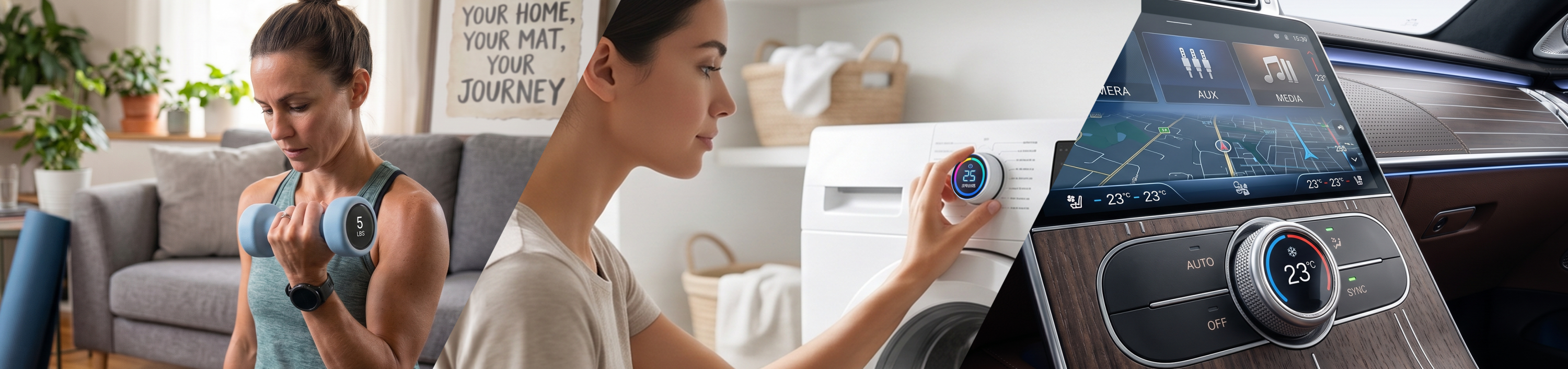
Round Display technology is rapidly becoming a defining feature of modern smart devices. From smartwatches and motorcycle dashboards to premium coffee machines and industrial control systems, a Round Display offers a unique combination of functionality, aesthetics, and user experience that traditional rectangular screens simply cannot match.
If you are looking for ways to differentiate your product design while maintaining intuitive usability, this guide explores why a Round Display Monitor may be the ideal solution.
|

|
Why Are Round Displays Less Common? The Hidden Costs Behind Circular Screens
|
|
Although circular displays are increasingly popular, rectangular screens still dominate the market. The reason is simple: the entire display ecosystem was originally built around rectangular panels.
1. Digital Content Is Designed for Rectangular Layouts
Modern operating systems, websites, videos, and user interfaces are all based on traditional X-Y coordinate systems. Challenges include:
| » | Important information can be cut off near the edges. |
| » | Text becomes harder to format and read. |
| » | User interfaces often require complete redesigns for circular layouts. |
| » | Software development costs increase significantly. |
2. LCD Manufacturing Favors Rectangular Panels
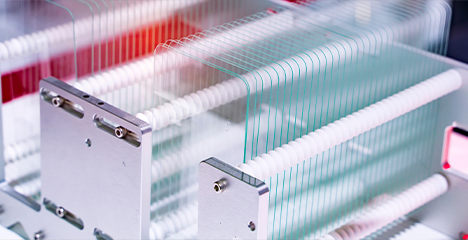
Display panels are produced on large rectangular glass substrates. Creating a circular display requires cutting round shapes from rectangular sheets, generating more unused material and increasing production costs.
3. Limited Economies of Scale
Unlike smartphones, tablets, and laptops that benefit from massive production volumes, circular displays are primarily used in niche markets. Manufacturers often need dedicated mask designs, custom tooling, and specialized circuit routing, resulting in higher development and manufacturing costs.
Did You Know?
Some low-cost products use a rectangular display hidden behind a circular cover. While visually similar, these solutions typically offer lower display utilization and a less immersive appearance than a true round display panel.
|
|
Why Some Applications Need a Round Display
|
|
Despite higher costs, circular displays provide advantages that make them indispensable in certain industries:
| » |
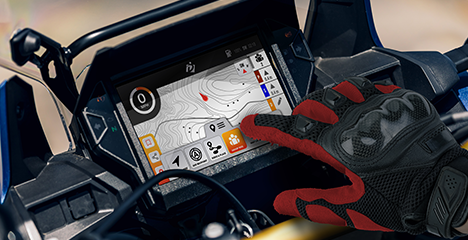
Motorcycle and Off-Road Vehicle Dashboards: Round displays preserve the classic appearance of analog gauges while integrating modern features such as navigation, connectivity, and multimedia functions. Riders can also interpret speed and RPM information more naturally using peripheral vision. |
| » |
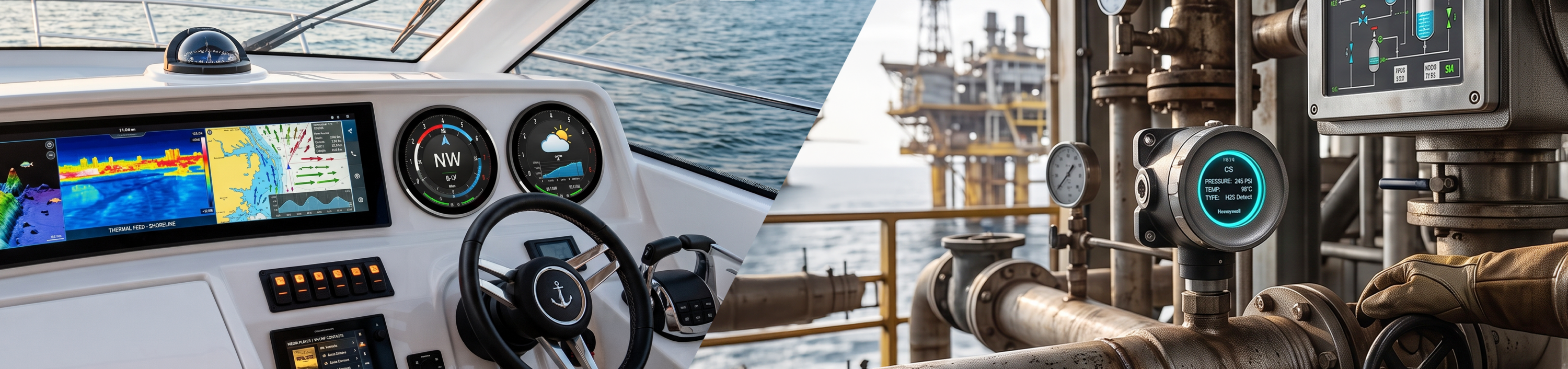
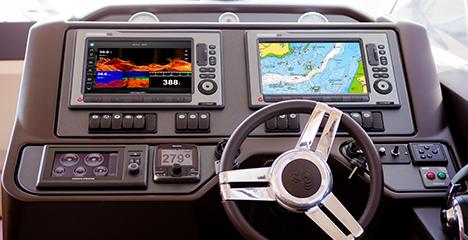
Marine Electronics and Industrial Instruments: Many marine and industrial systems already use standardized circular mounting holes. A round display allows manufacturers to upgrade existing equipment without redesigning enclosures or waterproof sealing structures. Circular screens are also ideal for radar, sonar, compass, and gauge-style visualizations that naturally follow a 360-degree format. |
| » |
Premium Home Appliances and Smart Home Devices: In products such as coffee machines, thermostats, water purification systems, and smart controllers, circular displays integrate naturally with rotary knobs. Combined with circular user interfaces, they create a highly intuitive control experience. |
| » |
Gaming, Entertainment, and Commercial Displays: A Round Monitor Display immediately stands out in environments dominated by rectangular screens. Circular displays are particularly effective for roulette systems, gaming machines, and luxury retail installations where visual differentiation is critical. |
| Motorcycles |
Off-Road Vehicles |
Marine Electronics |
| Industrial Gauge |
Home Appliances |
Smart Controllers |
|
4 Key Advantages of Round Display Technology
|
|
Seamless Integration
Round displays fit naturally into traditional circular enclosures used in motorcycles, marine systems, industrial equipment, and consumer appliances.
|
|
|
Enhanced Ergonomics
When paired with rotary controls and circular interfaces, users can operate systems more intuitively and efficiently.
|
|
|
Smart Functionality
A round display can combine navigation, connectivity, monitoring, and control functions within a familiar circular format and compact space.
|
|
|
Distinctive Visual Impact
Circular displays are highly recognizable and create stronger visual differentiation, helping products stand out in competitive markets.
|
|
Round Display vs. Traditional Monitor
| Comparison Area |
Round Display |
Traditional Display |
| UI Design |
Requires customized circular interfaces |
Supports standard UI layouts |
| Mechanical Integration |
Ideal for circular housings and gauges |
Best suited for flat rectangular spaces |
| Manufacturing Cost |
Higher customization and tooling costs |
Mature, cost-efficient production |
| User Experience |
Excellent for rotational controls and circular graphics |
Optimized for general-purpose applications |
|
The Engineering Secret Behind Round Displays
|
|
Many people are surprised to learn that a circular display is actually built on a traditional pixel matrix. Internally, pixels remain arranged in a standard rectangular grid. Manufacturers simply shape the panel into a circular form and disable pixels outside the visible display area. This approach maintains compatibility with standard display interfaces such as HDMI and DisplayPort while preserving manufacturing efficiency.
For UI designers, this means content is still created within a square canvas, but critical information must be positioned toward the center to avoid edge cropping.
|
Common Round Display Sizes and Applications
Here is a breakdown of the standard round display dimensions, technical characteristics, and target application scenarios:
✓ Small Displays (1.3"– 2.1")
• Typical resolutions: 320×320 to 480×480
• Applications: Fitness devices, home appliances, smart thermostats, knob for vehicle device.
|
✓ Medium Displays (3"– 3.5")
• Typical resolutions: 432×432 to 800×800
• Applications: Motorcycle instrument clusters, smart thermostats, knob for gaming.
• Wide operating temperatures from -35°C to +85°C.
|
✓ Large Displays (4"– 4.2")
• Typical resolution: 720×720
• Brightness up to 1,300 nits for outdoor visibility.
• Applications: Marine navigation systems, engine gauge, industrial HMI platforms.
|
✓ Unique Displays (23.6")
• Typical resolution: 848×848
• Applications: Advertisement.
|
|
Data Image: Rugged Round Display Solutions for Demanding Environments
|
|
Data Image specializes in high-performance Round Display solutions for outdoor, industrial, marine, and transportation applications. With a complete product portfolio ranging from 1.3-inch to 4.2-inch displays, customers can upgrade existing systems without major mechanical redesigns.
Curved Glass Optical Bonding
Designed for demanding outdoor environments, Data Image offers advanced 2.5D and multi-curvature glass solutions combined with optical bonding technology. This approach helps reduce reflections, improve sunlight readability, enhance structural durability, and deliver a premium visual appearance. For applications exposed to direct sunlight, selected models support brightness levels of up to 1,200–1,300 nits, ensuring excellent visibility in motorcycle dashboards, marine navigation systems, and industrial control equipment.
|
Physical Pointer Integration
Many premium motorcycles continue to embrace the visual appeal of traditional analog gauges. To support this design philosophy, Data Image has developed precision center-hole display technology that allows a mechanical needle to coexist with a digital display. Combined with a high-rigidity aluminum-magnesium backlight structure, this solution maintains excellent reliability even under severe vibration, harsh weather conditions, and demanding industrial environments. Manufacturers can preserve the emotional appeal of analog instrumentation while adding navigation, connectivity, and advanced digital functions.
|
Flat Tire Design
Not every installation has enough space for a perfect circle. Data Image's unique Flat Tire Design features a precision-cut flat edge along the bottom of the display, reducing overall installation height while maintaining the distinctive appearance of a round screen. This design is particularly valuable for motorcycle instrument clusters, compact control panels, and applications with limited mounting space, allowing engineers greater design flexibility without requiring major enclosure modifications.
|
As product designers seek new ways to enhance user experience and create stronger brand differentiation, Round Display technology continues to gain momentum across automotive, marine, industrial, and smart appliance applications. A Round Display Monitor delivers unique ergonomic, aesthetic, and functional advantages that conventional rectangular screens cannot replicate.
|
Ready to Integrate a Round Display into Your Next Design?
Contact Data Image to discover how our engineering expertise, optical bonding technologies, and customization capabilities can transform your concept into a reliable, production-ready solution.
|
|
#DataImage #RoundDisplay #CircularScreen #UXDesign #OpticalBonding #FlatTireDesign #PhysicalPointer #DashboardDesign #IndustrialHMI #MarineElectronics
*All images are for illustrative purposes only. Actual product may vary.
|
|


 Back
Back


.png)