
.png)


Optical Bonding Facilities
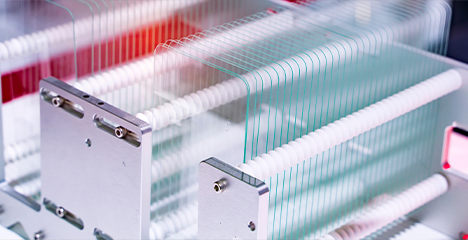
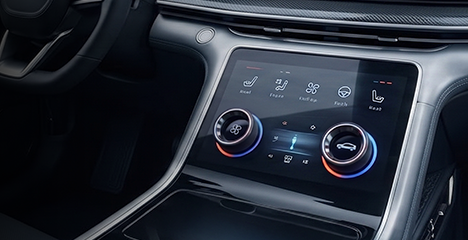
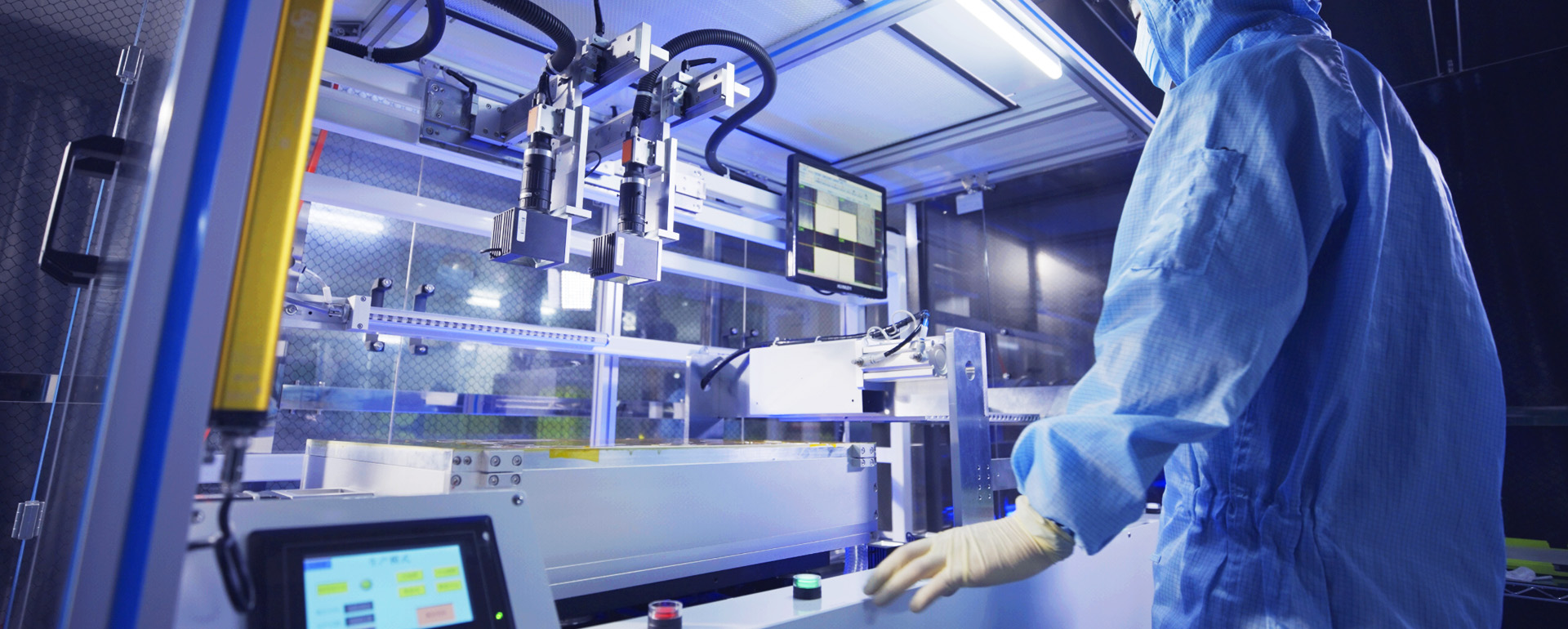
To ensure consistent and stable quality, Data Image operates its own in-house optical bonding production line. Optical bonding improves LCD readability and durability, supporting reliable performance in industrial and outdoor environments. With controlled internal processes and validation, we can recommend the right bonding approach for different use cases—while maintaining high quality across a wide range of panels and project requirements.

Improved readability in sunlight

Reduce reflection

Enhance Ruggedness and durability

Prevents condensation or fog on the display
Core Technology
Optical Bonding
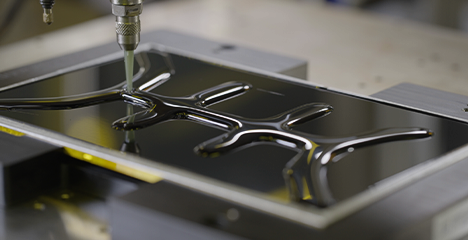
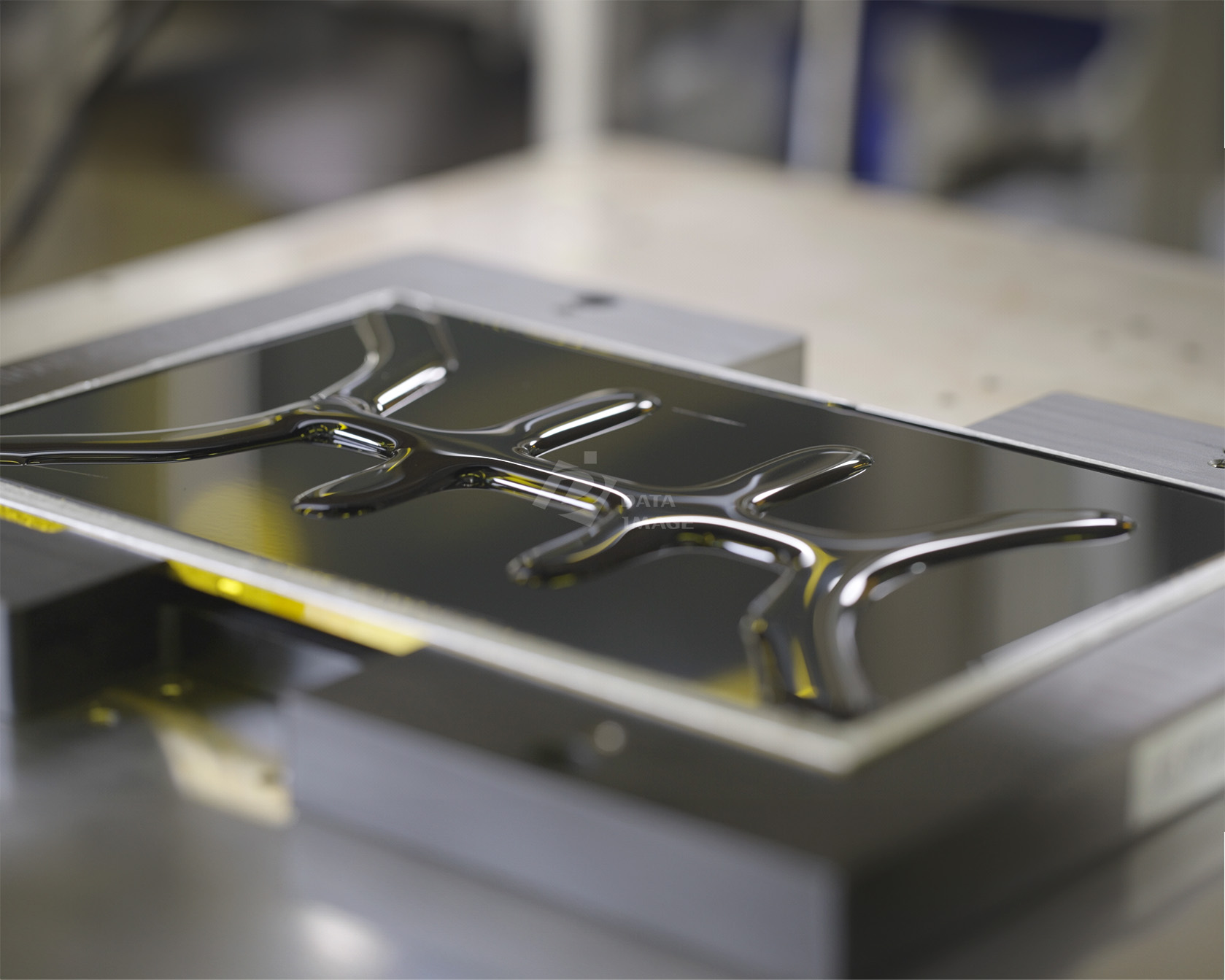
Optical bonding can be implemented with different processes and materials—such as silicone, polyurethane, epoxy, and acrylic-based adhesives—selected based on the product structure and application needs. These bonding materials are typically cured through controlled mixing and curing conditions, including heat curing or UV curing. Depending on the design and production requirements, bonding can be performed as wet bonding (LOCA) using a liquid adhesive, or as dry bonding (OCA) using a pre-formed optically clear adhesive film.
As with any adhesive process, material selection directly impacts long-term durability, and strong adhesion and compatibility with the component surfaces are equally critical. To ensure consistent bonding quality, we apply dedicated surface preparation before bonding, including a two-stage pre-treatment process to improve adhesion performance and overall reliability. This approach helps stabilize the bonding process—even on more challenging surfaces—resulting in stronger, more reliable bonding outcomes.
Types of Optical Bonding
Optical bonding types are generally classified by the application method (liquid vs. dry) or by the specific adhesive material used to laminate a display panel to its cover glass or touchscreen.
Dry Bonding
Uses a solid-form adhesive material, applied under vacuum without any liquid curing step; well suited to standard commercial displays.
Wet Bonding
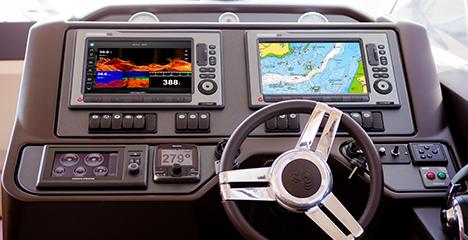
Uses a liquid or gel-like adhesive that is dispensed and cured in place, offering stronger environmental resistance for demanding applications such as automotive and marine displays.
OCA (Optically Clear Adhesive)
A wet bonding method that provides a faster, lower-cost solution with good durability and readability.
OCR (Optically Clear Resin)
A wet bonding method offering the highest durability and readability, particularly under direct sunlight or high-impact conditions.
The following sections outline the process and characteristics of each bonding type in detail.

Dry Bonding
Dry bonding utilizes precision-cut solid adhesive sheets to seamlessly bridge the gap between the cover lens and display panel. Processed inside a high-vacuum chamber, this dry-lamination method completely eliminates air gaps without the risk of liquid overflow or uneven resin spread. By selecting the optimal film thickness tailored to specific bezel and frame heights, dry bonding ensures consistent bond-line uniformity, high yield rates, and efficient cycle times for automated mass production.

Wet Bonding
Wet bonding involves dispensing a specialized liquid or gel optical adhesive directly onto the panel before curing it via UV light or heat. Because the liquid adhesive naturally flows to fill gaps without mechanical pressure, it excels at accommodating irregular surfaces, curved cover glasses, and large-format displays with zero stress. This curing process forms a seamless, resilient bond layer that provides superior sealing and structural integrity across diverse display assemblies.

OCA
OCA is a pre-formed, highly transparent solid adhesive film designed for standard flat lamination. By matching the refractive index between glass and display layers, OCA effectively eliminates internal reflections, enhances contrast, and maximizes display brightness. Delivering a clean, fast, and cost-effective optical bonding solution, OCA is widely adopted in consumer electronics, handheld devices, and light industrial HMIs.

OCR
OCR, also known as LOCA, is a high-performance liquid resin formulated for demanding environments. Once cured, it creates a robust, shock-absorbing barrier that delivers maximum resistance to severe vibrations, mechanical impact, thermal cycling, and high humidity. Offering exceptional sunlight readability and long-term anti-yellowing performance, OCR is the premier choice for automotive, marine, defense, and rugged outdoor displays.
Optical Bonding Key Benefits
Optical bonding delivers measurable improvements in visual performance and mechanical durability compared to traditional air-gap or perimeter-bonded displays.
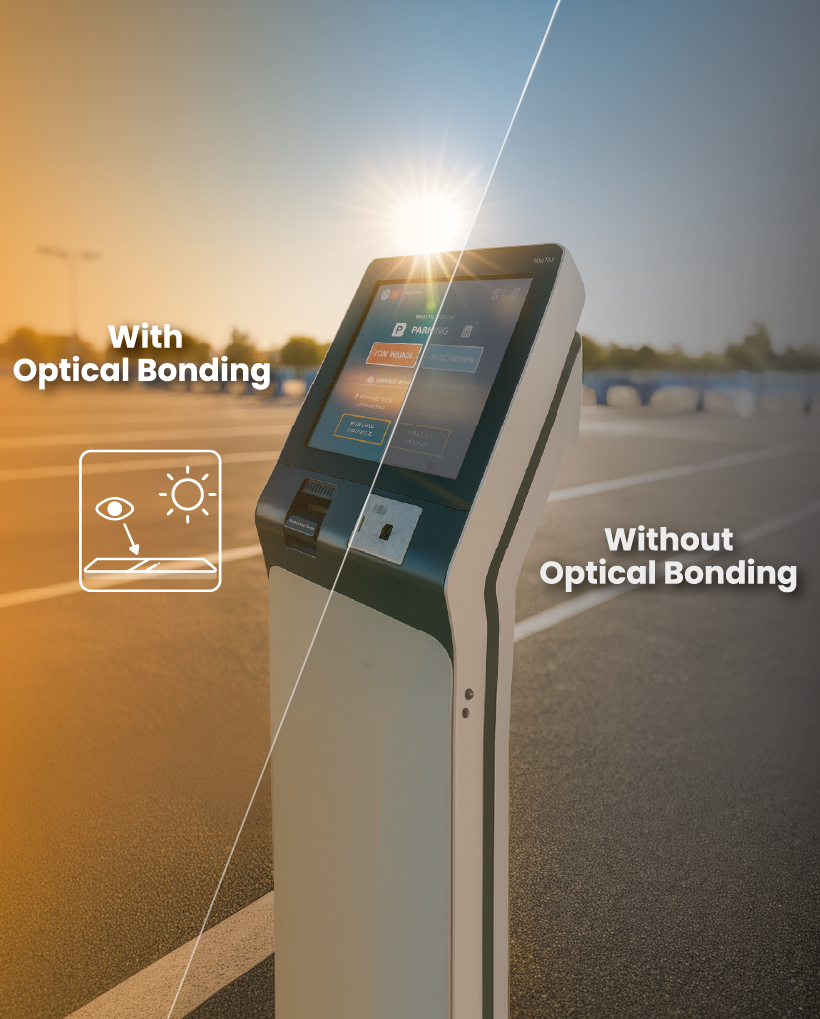
.Better Sunlight Readability
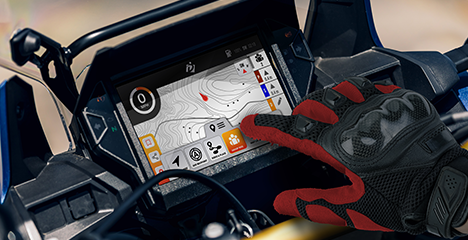
Eliminating the air gap stops light from bouncing around internally, raising the contrast ratio so the screen stays clear and easy to read, even outdoors in direct sunlight.
.No Fog or Dust
The solid adhesive layer seals the display stack completely, keeping dirt and moisture from getting inside and protecting internal components over the long term.
.Tougher Build
The bonded glass resists drops, impacts, and heavy vibration far better than an unbonded screen, making it suitable for rugged industrial, military, and transportation applications.
.More Exact Touch Response
Removing the empty air gap eliminates parallax-related touch errors, making touch inputs feel precise and directly connected to what's on screen.
.Lower Parallax
With light passing through a single index of refraction instead of an air gap, the visual displacement between the touch surface and the display content is minimized, improving overall optical accuracy.
Optical Bonding Processes
Optical bonding follows a controlled, multi-step process from surface preparation through final quality inspection to ensure a clean, durable bond. The process generally includes the following steps:
Preparation
The display panel and cover glass are thoroughly cleaned to remove dust or particles that could compromise the bond.
Adhesive Application
A layer of dry or liquid adhesive is applied to the panel or cover glass, depending on the bonding type selected.
Bonding
The cover glass is aligned and placed onto the panel, and the adhesive is cured using UV light or heat to form a permanent bond.
Inspection
The bonded assembly is inspected for bubbles, misalignments, or other defects before moving forward in production.
Which Optical Bonding Process Is Right for You?
There's no one-size-fits-all answer—the ideal bonding process depends on where and how the display will be used. Share your application details with us, including operating environment, mechanical constraints, and reliability targets, and our team will recommend the most suitable bonding approach: one that meets your performance requirements without adding unnecessary cost.
Built to Perform, Wherever You Need It
Every display we produce is engineered with reliability in mind. From high altitude and rapid pressure changes to extended operating temperatures, constant shock and vibration, and prolonged exposure to moisture, our components are tested and built to keep performing under conditions that would compromise a standard display.
At the core of that reliability is optical bonding. By eliminating the air gap between bonded interfaces, it minimizes internal condensation and strengthens long-term durability in outdoor and high-humidity environments—so wherever your display is deployed, it's built to last.